















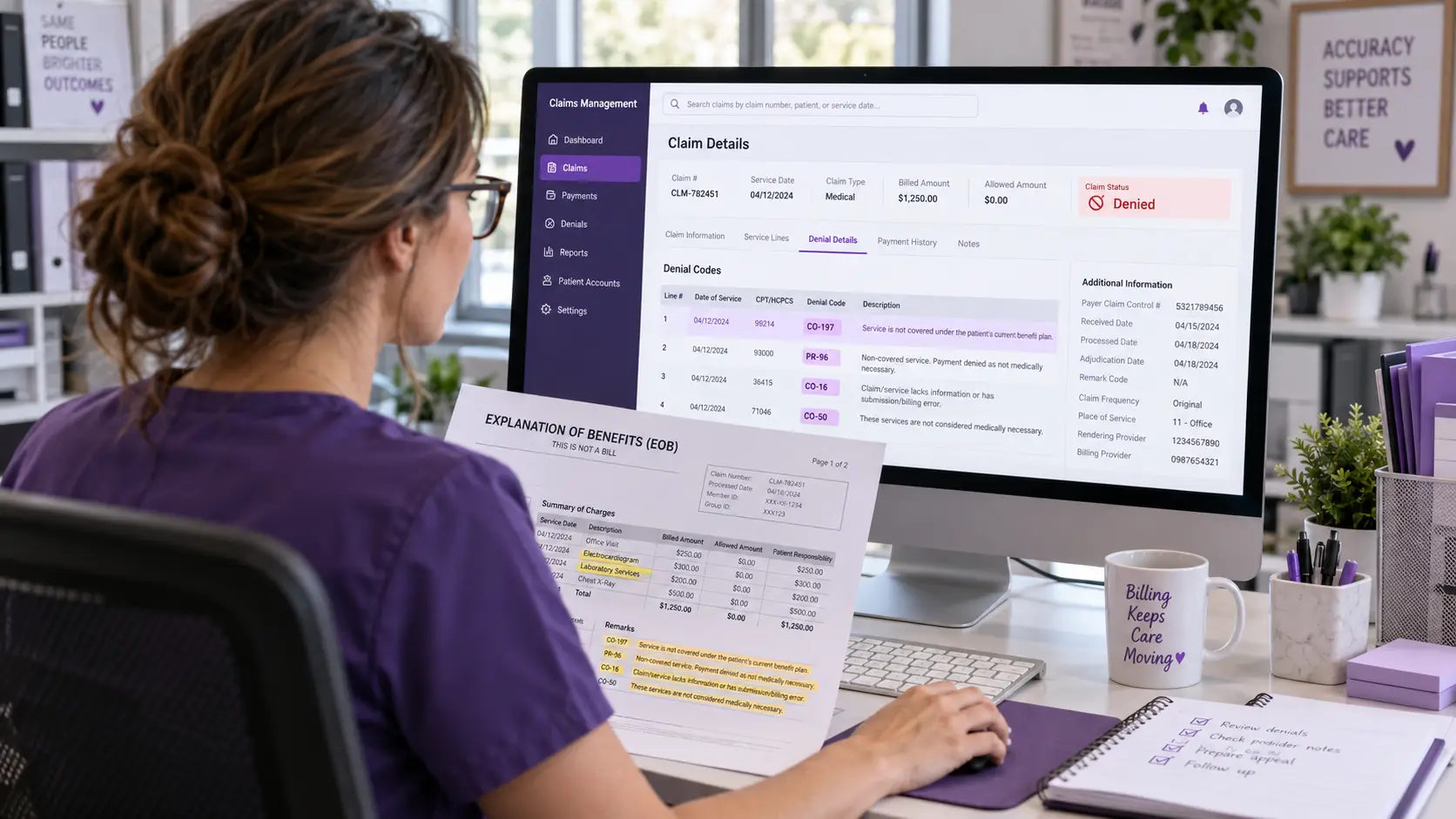
A denied claim is revenue you have already earned but not yet collected. Industry data puts average initial denial rates between 10% and 15%, and a large share of those denials are never reworked. Most of them are preventable with the right checks before a claim leaves the office with our healthcare outsource billing workflow.
This guide covers the denial reasons we see most often across the practices we support, the claim adjustment reason codes (CARCs) behind them, and the workflow changes that stop them at the source.
Why denials matter more than you think
Every denial costs staff time to research, correct and resubmit. Reworking a single claim typically costs $25 to $118 depending on complexity, and each rework cycle adds weeks to your AR. Denials that are never appealed become permanent write-offs, which our revenue cycle management team works systematically to eliminate.
Roughly two-thirds of denied claims are recoverable, but many practices never resubmit them because no one has time to follow up.
7 most common claim denial reasons
1. Missing or invalid eligibility
Coverage terminated, wrong member ID, or the plan does not cover the service. This is the single largest preventable denial category.
2. Missing prior authorization
Imaging, procedures and specialty drugs often need approval before the visit. A missing or expired authorization is rarely recoverable.
3. Coding errors
Wrong CPT level, unbundled codes, outdated ICD-10 codes or missing modifiers such as 25 and 59.
4. Medical necessity not supported
The diagnosis code does not justify the procedure, or documentation is too vague to support it.
5. Duplicate claims
Resubmitting a claim that is still processing triggers an automatic duplicate denial.
6. Timely filing limits
Each payer sets its own deadline, commonly 90 to 365 days from the date of service. Late claims are denied outright.
7. Coordination of benefits
The wrong payer was billed as primary, or the patient’s other coverage was never updated.
Common denial codes at a glance
| Code | What it means | Prevention |
|---|---|---|
CO-16 | Claim lacks information or has billing errors | Pre-submission claim scrubbing |
CO-27 | Expenses incurred after coverage terminated | Real-time eligibility check |
CO-197 | Precertification or authorization absent | Authorization tracking before visit |
CO-11 | Diagnosis inconsistent with procedure | Coder review of ICD-10 linkage |
CO-18 | Exact duplicate claim | Claim status check before resubmitting |
CO-29 | Time limit for filing has expired | Submit within 24–48 hours |
CO-22 | Care may be covered by another payer | Coordination of benefits update |
How to prevent claim denials
Denial prevention works best at the front end, before the patient is seen. These steps cover the majority of preventable denials:
- ✓Verify eligibility and benefits 24–48 hours before every visit, not at check-in.
- ✓Track prior authorizations against scheduled appointments and flag expiring approvals.
- ✓Scrub every claim against payer-specific edits and NCCI bundling rules before submission.
- ✓Have AAPC-certified specialists review documentation for medical necessity and correct modifier use through professional medical coding services.
- ✓Submit clean claims within 24–48 hours of the encounter to stay well inside filing limits.
- ✓Update coordination of benefits at every visit and confirm the primary payer.
What to do when a claim is denied
Start with the CARC and RARC codes on the remittance. They tell you whether the denial needs a corrected claim, additional documentation or a formal appeal. Correct and resubmit administrative denials within a few days. For medical necessity denials, attach clinical notes and a clear appeal letter that ties the diagnosis to the service performed.
Finally, log every denial by reason and payer. Patterns show you which front-end step is breaking, which is how denial rates actually come down over time.
Key takeaways
Most denials are caused by eligibility, authorization and coding errors that can be caught before submission.
Every denial code points to a specific fix in your workflow.
Track denials by reason and payer to find and fix root causes.
Outsourced billing teams reduce denials by running these checks on every claim.