









Outsource Wound Care Billing For Accurate Debridement Coding & Maximum Reimbursement
A high-acuity discipline in our medical billing specialties, skin substitute billing, prior authorization for advanced procedures, and chronic wound documentation requirements compound the complexity. Our Outsource Wound Care Billing specialists manage the full revenue cycle so your clinical team can focus on healing wounds.
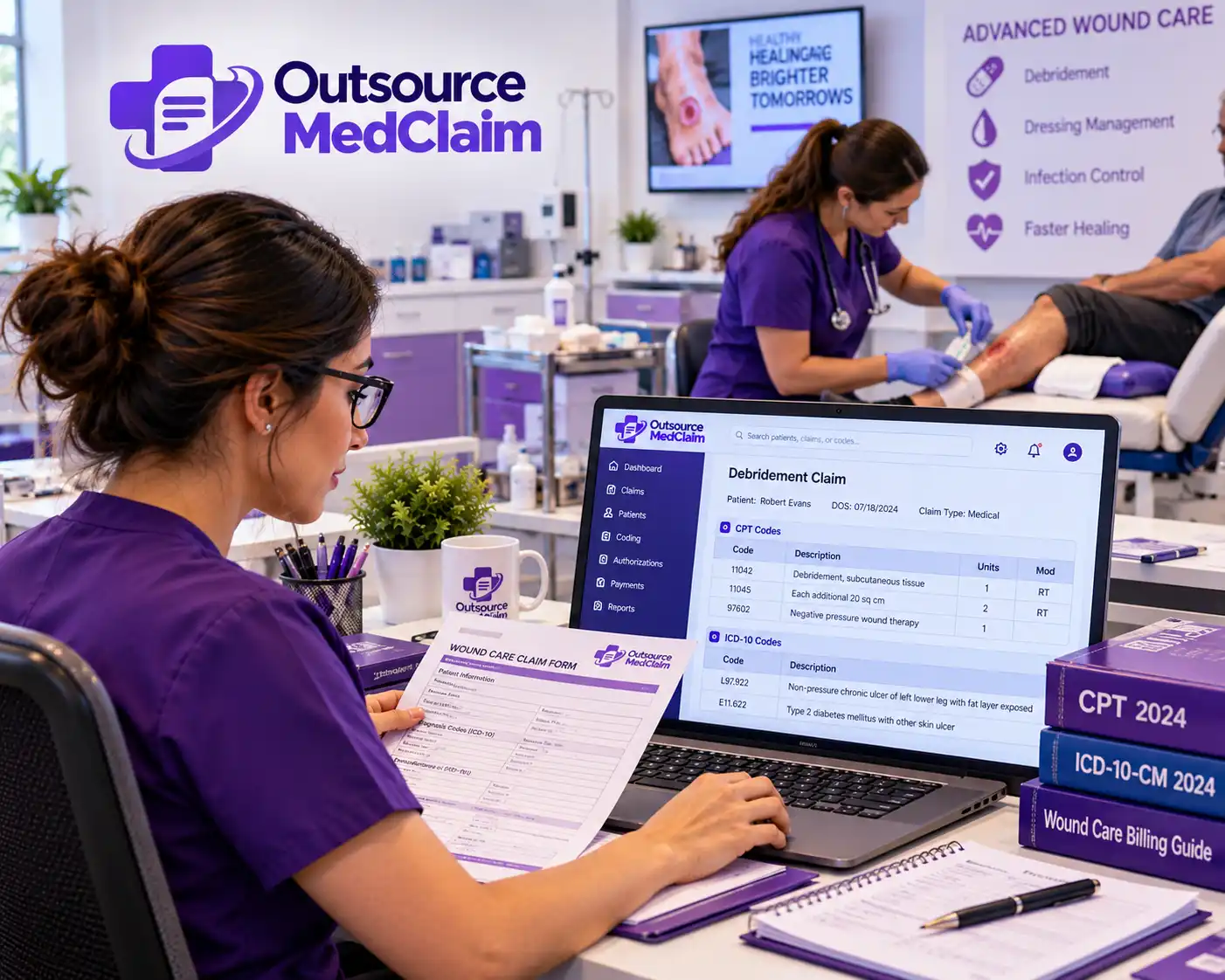
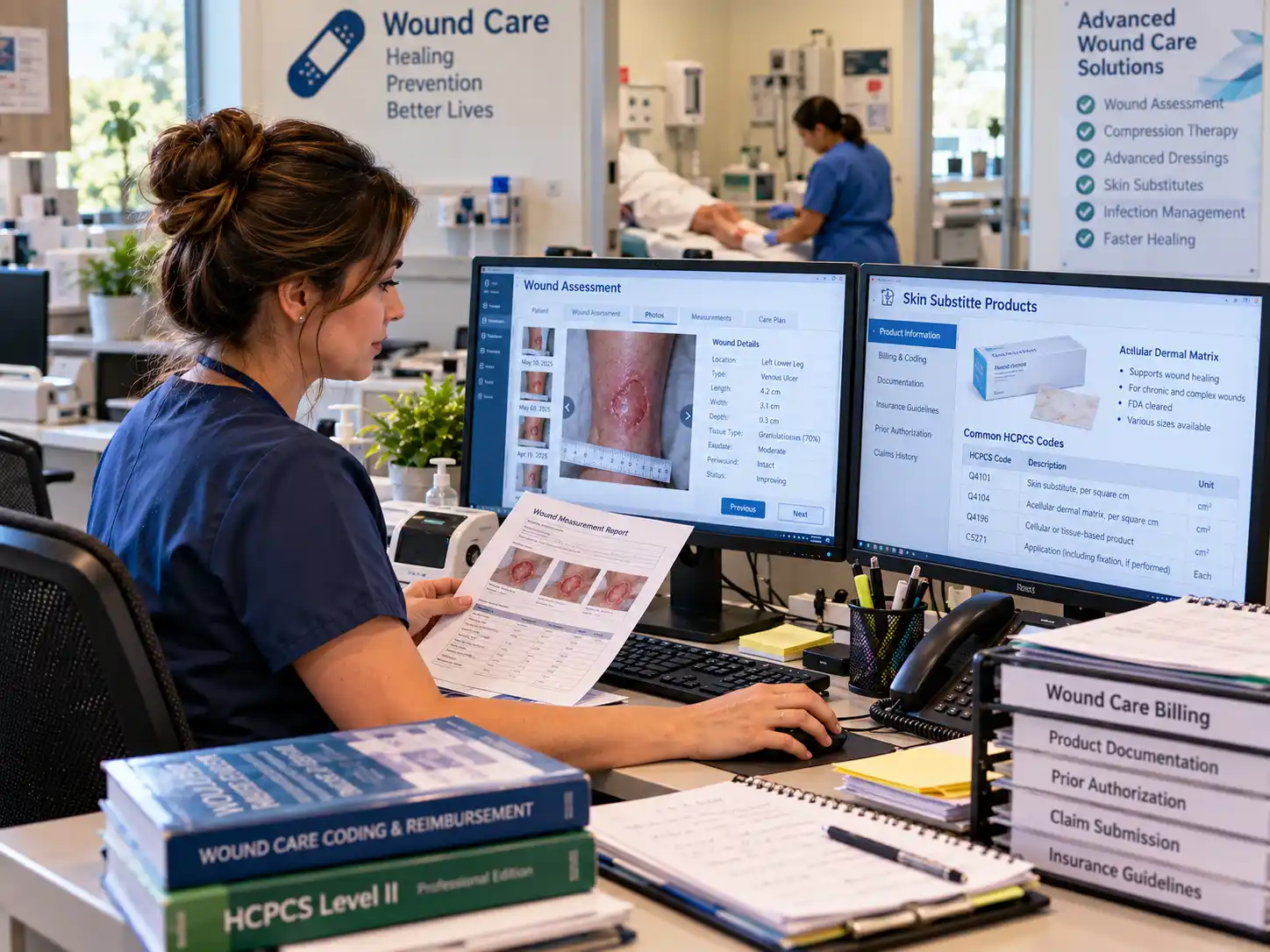
Why Providers Outsource Wound Care Billing
Wound care billing is highly specialized, requiring certified medical coding services, detailed documentation, and dedicated healthcare outsource billing. Services such as debridement, chronic wound management, and advanced wound therapies often face greater payer scrutiny, making billing errors costly and time-consuming to resolve.
The complexity increases when practices use skin substitutes, grafts, and advanced wound products, which require active wound care provider credentialing and prior authorizations. Even minor documentation gaps can lead to denied claims, delayed payments, and lost revenue.
Managing these requirements internally can place significant pressure on administrative teams, especially in high-volume wound care clinics. Staff must track payer policies and follow up on accounts, frequently collaborating with infusion suites and family medicine physicians.
Outsourcing wound care billing services gives providers access to specialists who understand wound care coding, compliance standards, and payer requirements. By improving claim accuracy, reducing denials, accelerating reimbursements, and managing the entire revenue cycle management (RCM), outsourced billing helps wound care practices protect revenue while focusing on patient outcomes.
Common Challenges in Wound Care Billing and Coding

Debridement Coding Confusion
Selecting between selective debridement (97597, 97598) and surgical debridement (11042–11047) depends on the deepest tissue layer actually removed, not wound severity or depth. This single distinction drives more wound care denials than any other coding error.

Skin Substitute & Graft Billing Complexity
Skin substitute application codes require precise product documentation, application site detail, and unit calculations tied to the current CMS reimbursement structure, an area facing increased scrutiny and documentation requirements in recent fee schedule updates.

Chronic Wound Documentation Requirements
Medicare requires wound measurements (length × width × depth), tissue composition, instruments used, and a documented healing trajectory at each visit. Repeated visits showing no change in wound size or new clinical findings are recognized as a denial and an audit trigger.

Prior Authorization Delays
Advanced wound procedures, including skin substitute application and negative-pressure wound therapy, often require prior authorization. Authorization lapses produce denials for procedures already performed, with limited recovery after the fact.

Incorrect ICD-10 Coding for Wound Conditions
Wound diagnosis codes must precisely reflect anatomic site, laterality, and severity stage, and, for diabetic ulcers, diabetes must be sequenced first in the diagnosis order. Unspecified or imprecise diagnosis codes routinely fail medical necessity review.

Claim Denials & AR Backlog
Wound care claim denial rates run two to three times higher than general medical claims. Without structured, depth-aware coding review and consistent payer follow-up, denied claims accumulate into AR backlogs faster than most in-house teams can resolve.
Wound Care CPT, HCPCS, and ICD-10 Coding Expertise
Accurate wound care billing depends on proper tissue-depth coding and surface area calculations. Our specialists apply current CPT, HCPCS, and ICD-10 guidelines to ensure claims are coded correctly, reduce denials, and support faster reimbursement.
| Procedure | CPT / HCPCS Code | Key Billing Rule |
|---|---|---|
| Selective Debridement (Initial) | 97597 | Open wounds 20 sq cm or less; removes devitalized tissue (slough, fibrin, biofilm) without excising healthy tissue |
| Selective Debridement (Additional) | 97598 | Each additional 20 sq cm or part thereof; cannot stand alone, 97597 must appear on the same claim |
| Surgical Debridement (Subcutaneous) | 11042 | First 20 sq cm; billed when documentation confirms subcutaneous tissue was surgically excised, not merely exposed |
| Surgical Debridement (Each Additional) | 11045 | Add-on to 11042 for each additional 20 sq cm at the subcutaneous depth |
| Surgical Debridement (Muscle/Fascia) | 11043 | First 20 sq cm; requires documentation that muscle and/or fascia tissue was removed, more intensive than 11042 |
| Surgical Debridement (Bone) | 11044 | Requires confirmation that cortical bone was actively debrided to healthy bleeding margins; exposed bone alone does not justify this code |
| Negative Pressure Wound Therapy | 97605, 97606 | Durable (reusable) pump systems; disposable pumps use 97607–97608; cannot be billed alongside debridement codes for the same wound on the same date |
| Skin Substitute / Graft Application | 15271–15278; HCPCS Q-codes | Requires product-specific HCPCS code, application site documentation, and unit calculation; subject to CMS flat-rate reimbursement structure updates |
| Wound Assessment & Evaluation | 99202–99215 | E/M codes for evaluation visits; modifier 25 required when billed alongside a procedure on the same date |
The Depth Rule: A Common Cause of Wound Care Claim Denials
Wound care coding is based on the deepest tissue actually removed during debridement, not the overall depth of the wound. When documentation does not clearly support the level of tissue removed, claims can be denied, downcoded, or flagged for audit.
Another common issue occurs when selective, surgical debridement codes are reported for the same wound on the same date of service. Payers closely monitor these coding scenarios, making accurate documentation and code selection essential to prevent denials and protect reimbursement.
All coding reflects current AMA CPT descriptor language, CMS wound care Local Coverage Determination (LCD) guidelines, and 2025–2026 fee schedule updates, including revised skin substitute reimbursement structure. Coding workflows are updated as CMS and the AMA publish changes.
Our Outsourced Wound Care Billing Services
Comprehensive wound care billing services covering every stage of the revenue cycle, managed by billing specialists trained specifically in depth-based debridement coding, skin substitute billing, and chronic wound documentation standards.

Insurance Eligibility Verification
Coverage and prior authorization status are confirmed before treatment, with re-verification at intervals for multi-month chronic wound treatment courses.
Wound Care CPT & ICD-10 Coding
Depth-based debridement code selection, skin substitute coding, and precise ICD-10 wound diagnosis assignment, including correct sequencing for diabetic ulcer claims.
Claim Preparation & Electronic Submission
Clean claims submitted with wound measurement documentation, tissue depth confirmation, and all required attachments for high-scrutiny procedures.
Prior Authorization Management
Full management of prior authorization for skin substitutes, advanced procedures, and negative pressure wound therapy, with renewal tracking across treatment courses.

Payment Posting & Reconciliation
Accurate EOB posting and reconciliation against Medicare and commercial fee schedules, with underpayment identification on skin substitute and graft claims.
Accounts Receivable Follow-Up
Structured follow-up on all outstanding claims, categorized by aging, payer, and denial type, with weekly AR review and escalation protocols.

Denial Management & Appeals
Root cause analysis on denied wound care claims, appeal preparation with depth and tissue documentation, and resubmission to recover revenue lost to preventable coding errors.

Patient Billing & Statements
Clear, compliant patient statements for copay and balance due amounts, with sensitivity to the financial circumstances common in chronic wound care patient populations.

Revenue Cycle Reporting & Analytics
Regular practice-level reporting on collections, denial trends by procedure type, AR aging, and prior authorization turnaround performance.
Wound Care Billing Process We Follow
Every wound care encounter follows a structured workflow built around the documentation and depth-coding accuracy that drives first-pass claim approval.
Insurance Eligibility Verification
Coverage and prior authorization status are confirmed before treatment, re-verified at intervals throughout extended chronic wound care courses.
Clinical Documentation Review
Wound measurements, tissue depth, instruments used, and healing trajectory are reviewed for completeness before coding begins.
CPT & ICD-10 Code Assignment
Code selected based on documented tissue depth removed, not wound severity, with correct ICD-10 diagnosis sequencing applied.
Claim Preparation & Submission
Clean claims submitted with all required wound documentation attachments, within 24–48 hours of clinical record receipt.
Claim Tracking & Payer Follow-Ups
Active follow-up on all pending claims within payer-specific processing windows, no claim left unmonitored.
Payment Posting & Reconciliation
EOBs posted and reconciled against Medicare and commercial fee schedules; skin substitute underpayments flagged for recovery.
AR Follow-Ups & Denial Management
Denials appealed with depth and tissue documentation. AR aging is reviewed weekly to prevent revenue from aging past recovery thresholds.
Technology and EHR Integration for Wound Care Billing
Our billing team works directly within the Electronic Health Records (EHR) and practice management platforms your wound care practice already uses. Wound measurement data, tissue depth documentation, and treatment progress notes flow from your clinical system into billing workflows without manual re-entry, preserving the precise documentation that depth-based coding requires.
National Provider Identifier (NPI) management is coordinated with billing operations to keep provider enrollment active across all payers, preventing enrollment gaps that interrupt reimbursement for high-value skin-substitute and advanced-procedure claims.
Direct integration with your wound care EHR platform
Wound measurement and tissue depth data pulled from clinical documentation
Real-time eligibility and prior authorization status tracking
Payment posting directly to patient ledgers in your existing system
AR and denial reporting through your practice management dashboard





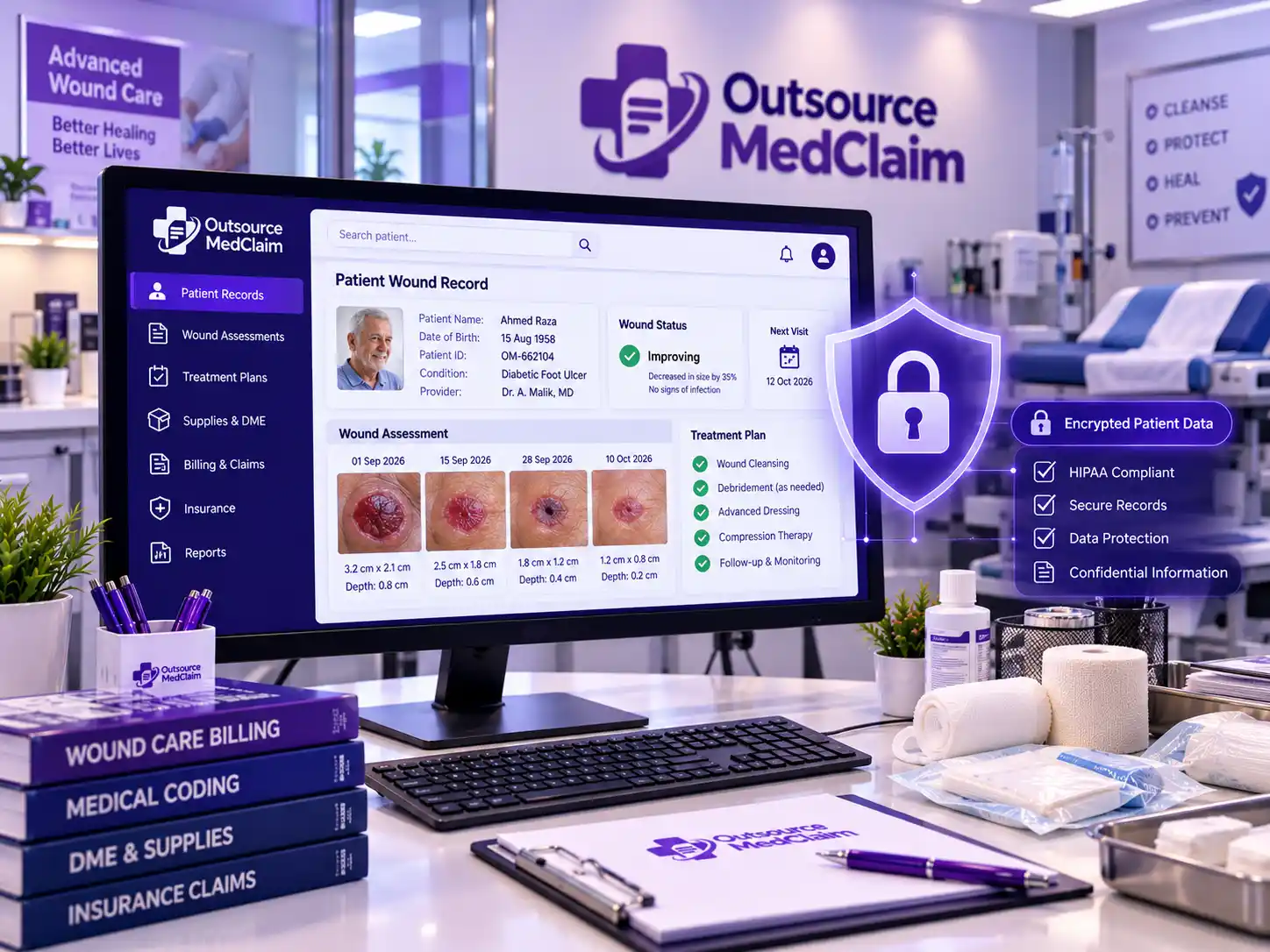
HIPAA-Compliant Wound Care Billing Services
Patient treatment records, wound documentation, and insurance information processed during billing are protected health information under HIPAA. All wound care billing workflows at Outsource MedClaim are operated under full HIPAA compliance, with encrypted data transmission, role-based access controls, and a signed business associate agreement (BAA) at the start of every engagement.
Compliance with CMS billing guidelines is maintained across every claim, including depth-based debridement documentation standards and skin substitute reimbursement requirements, which carry significant audit exposure when handled incorrectly.

Benefits of Outsourcing Wound Care Billing Services
Faster Reimbursements
Clean claims with complete depth and tissue documentation reduce processing delays and prevent claims from sitting unresolved in payer queues.
Reduced Claim Denials
Accurate depth-based code selection and pre-submission documentation review eliminate the errors responsible for wound care's elevated denial rate.
Higher Billing Accuracy
Specialty-trained coders applying current AMA descriptor language and CMS LCD guidelines produce fewer errors and stronger reimbursement per encounter.
Improved Revenue Cycle Performance
Every stage, eligibility, coding, prior authorization, and AR resolution are managed with workflows built specifically for wound care's documentation-intensive billing model.

Reduced Administrative Burden
Clinical and front-office staff are freed from prior authorization chasing, denial rework, and depth-coding second-guessing, allowing them to return their focus to patient care.
Better Financial Reporting
Regular reporting on collections by procedure type, denial trends, and AR health gives wound care leadership the data needed for accurate planning.
Proven Results for Wound Care Practices
The outcomes of specialist-managed wound care billing are measurable, in denial rates, collection speed, and revenue recovered from previously miscoded or uncontested claims.


Cost of Outsourcing Wound Care Billing Services
Outsourced wound care billing helps reduce costly denials and maximize reimbursement for high-value procedures and advanced wound therapies. For many practices, the revenue recovered from improved claim accuracy significantly outweighs the cost of outsourcing.
Percentage of Collections
A fixed percentage of monthly collections. Aligns billing performance directly with your revenue; we earn when you earn.
Per-Claim Fee
A flat fee per claim submitted. Suited to lower-volume wound care practices or specialty clinics with a narrower procedure scope.
Flat Monthly Billing
A consistent monthly fee covering all billing services regardless of volume, and a predictable overhead for clinics with stable patient flow.
Custom RCM Package
Tailored pricing for hospital wound care departments or multi-location chronic wound treatment groups.
What Our Clients Say
We were consistently billing 11044 based on wound depth rather than confirmed bone debridement, and didn't realize it was a documentation issue until Outsource MedClaim's initial audit flagged the pattern. Correcting our coding and documentation language significantly reduced our denial rate and removed an audit exposure we didn't know we had.
Skin substitute billing was our biggest revenue leak; between prior authorization lapses and unit calculation errors, we were losing money on some of our highest-cost procedures. Outsource MedClaim rebuilt our entire skin substitute billing workflow, and we haven't had an authorization-related denial since.
Our hospital wound care department was running a denial rate well above what our administration considered acceptable. Outsourcing MedClaim's depth-based coding review and documentation training to our clinical staff brought that number down substantially in the first quarter, and our AR aging has improved across the board.
Why Choose Our Wound Care Billing Company
Certified Medical Billing Specialists
Deep Expertise in Wound Care Coding
Dedicated Account Manager
Real-Time Reporting Dashboard
Scalable RCM Solutions
Proven Track Record
Frequently Asked Questions
Wound care commonly uses CPT codes 97597–97598 for selective debridement and 11042–11047 for surgical debridement based on tissue depth. Additional codes include 97605–97608 for negative pressure wound therapy and 15271–15278 for skin substitutes and grafts. Standard E/M codes (99202–99215) are also used for wound evaluations, often with modifier 25 when billed alongside procedures.
Outsourcing improves claim accuracy, reduces denials, and helps manage complex wound care coding and documentation requirements. It also supports better reimbursement for high-cost procedures and reduces administrative burden on clinical staff.
Accurate documentation must include wound measurements, tissue depth, type of debridement performed, and medical necessity. For time-based or procedure codes, detailed clinical notes are essential to support reimbursement and avoid audits.
Yes. We manage prior authorizations for advanced wound care treatments, including skin substitutes and specialty procedures, ensuring approvals are in place before services are rendered.
We reduce denials through accurate coding, thorough documentation review, eligibility verification, and payer-specific billing compliance. Our team also handles denial follow-ups and corrections to improve reimbursement rates.
Most wound care billing services can begin within a few weeks, depending on practice size and system integration requirements. We ensure a smooth onboarding process with minimal disruption.
Yes. All billing processes comply with strict HIPAA standards, including secure data handling, encrypted systems, and controlled access to patient information.
Yes. We handle insurance verification, eligibility checks, accounts receivable management, and ongoing follow-ups to ensure timely reimbursement and improved cash flow.
Start Outsourcing Wound Care Billing Today!
Depth-coding errors, skin substitute underpayments, and aging AR are recoverable revenue. Let our Wound Care Medical Billing Services specialists audit your current process.